
Beyond Accuracy: Why AI Chatbots Need Integrated Website Design
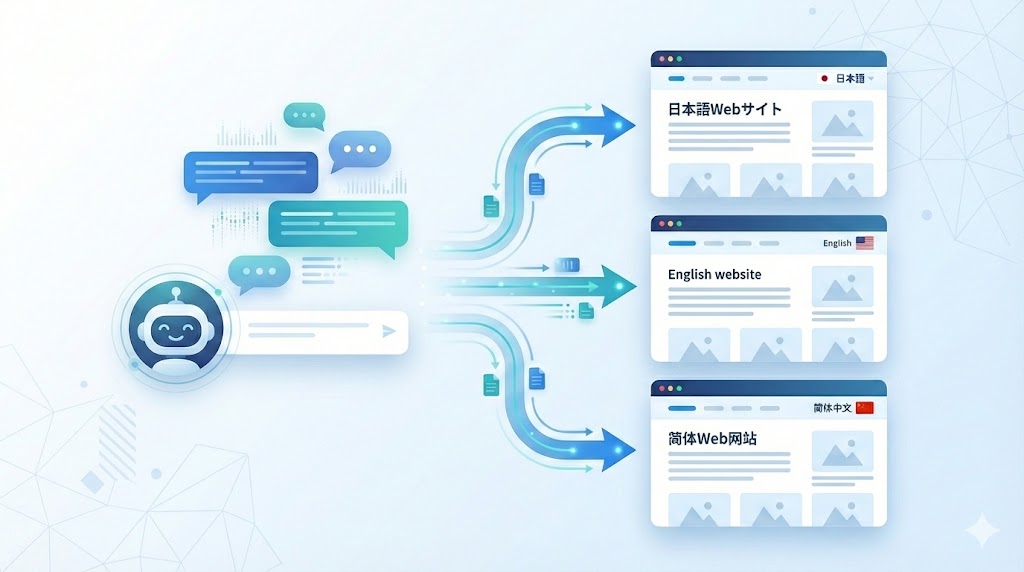
To maximize AI chatbot ROI, website integration is just as critical as response accuracy. We explain the pitfalls of multilingual support and SmartWeb's integrated design approach.
Many companies decide to introduce AI chatbots with the expectation that they will automate inquiry handling and answer customer questions 24/7/365 without wait times.
Indeed, the latest AI chatbots respond in surprisingly natural language and it is not rare for them to support over 50 languages. for simple questions like “What are your business hours?” or “What are the return conditions?”, a chatbot’s answer alone resolves the customer’s doubt.
But how should you handle questions that require more detailed information? One method is to lengthen the response to convey all information at once. However, if a long block of text appears in a chat UI, customers have to scroll to find necessary information, making it harder to use. Imagine an actual chat screen. If hundreds of characters of explanation are packed into a small bubble, wouldn’t you lose the will to read it?
As a result, many chatbot responses end with a referral to the website: “Please see here for details” or “Click here for the product page.” Here lies a problem that many companies overlook.
The Structure of “Mismatch” Between Chatbot and Website
In many companies, AI chatbots and websites are introduced as separate projects. Chatbot teams focus on refining FAQs and improving response accuracy, while Web teams work on SEO and design optimization. Each seems to be exercising their expertise, but this division of labor can create unexpected pitfalls.
The product page guided by the chatbot might contain outdated information on the website. The chatbot might say “Click here for campaign info,” but the page cannot be found. These mismatches structurally continue to occur as long as chatbots and websites are managed separately.
Multilingual support is particularly serious. Even if an AI chatbot answers perfectly in English or Chinese, if the linked web page is only in Japanese, the user will drop off there. No matter how many languages the chatbot supports, it is meaningless if the website doesn’t catch up.
For example, suppose an overseas customer asks in English, “Please tell me the size of this product.” The AI chatbot politely answers in English, “Width 420mm, Depth 300mm, Height 150mm. Please see the product page for a detailed dimensional drawing.” However, what if the linked product page is in Japanese? The notes in the dimensional drawing and installation precautions are all written in Japanese. The customer closes the page without being able to make the crucial judgment: “I know the numbers, but can I actually install it in my environment?”
The same happens with operation manuals and troubleshooting. For a request like “Please tell me how to set it up,” even if the chatbot explains the steps in text, there is much content that is hard to understand without seeing actual screen captures or diagrams. Even if it guides to a link saying “Please refer to this manual for detailed steps,” if that manual page is in Japanese, the button names and menu names in the figures cannot be read. In the end, the customer cannot reach a solution and ends up contacting human support.
According to one survey, about 75% of global customers prefer to purchase from websites in their own language. Even if you support foreign languages with a chatbot, if the website beyond it is only in Japanese, the multilingual chatbot becomes “multilingual only at the entrance.”
“Continuity of Experience,” Not “Response Accuracy,” Determines Results
The value of an AI chatbot cannot be measured by response accuracy alone. The user converses with the chatbot, moves to a web page, checks images and detailed information, and finally reaches an inquiry or purchase—this continuous experience without interruption determines actual conversions.
Even if a chatbot answers “This product is optimal for your company’s issues,” what users want to know are specific specifications, case studies, and price range. By supplementing information that cannot be fully conveyed by text alone with images, charts, and videos on web pages, user understanding deepens.
In fact, there is much information that is hard to convey with text alone. Consider comparing pricing plans. To the question “Which plan suits me?”, if the chatbot explains in text “The Standard Plan is 10,000 yen/month with basic functions. The Pro Plan is 25,000 yen/month adding advanced analysis functions,” it is hard for the customer to judge. They would want to compare function differences in a list and visually confirm if the functions they need are included in which plan. When the chatbot guides to the pricing page link, if that page is not displayed in the customer’s language and the comparison table is not readable, consideration will not proceed.
This tendency becomes more pronounced with technical content. Network diagrams, system architectures, connection flowcharts—such information cannot be accurately understood without seeing diagrams, no matter how carefully explained in text. Even if an overseas technical staff member asks via chatbot and gets an answer in their native language, if the referenced document is in Japanese, they cannot read the labels or notes in the diagram, and implementation consideration stops.
In other words, chatbots should not be designed as standalone tools, but as entry points utilizing the entire website as a “knowledge base.” Whether the chatbot can not only generate answers but also appropriately guide to relevant web pages divides the quality of customer experience.
There are reports that providing localized experiences improves international sales by 20-30%. This is not a number achievable simply by making the chatbot multilingual. It presupposes that the entire website is maintained in multiple languages and the path from chatbot to web page is unbroken.
Difference Between Standalone and Integrated Design
When considering chatbot introduction, the results obtained differ greatly depending on whether you “introduce a chatbot alone” or “design it integrally with the website.”
| Perspective | Chatbot Standalone Introduction | Integrated Design with Website |
|---|---|---|
| Response Accuracy | Can be high | Can be high |
| Detailed Info Provision | Text answer only | Can guide to images, videos, pages |
| Multilingual Support | Chat only multilingual | Website also multilingual, continuous experience |
| Conversion | Risk of drop-off midway | Easy to complete with natural flow |
| Information Freshness | Double management in Chat and Web, mismatch occurs | Content centralized, always synchronized |
| Operational Load | FAQ update and Web update are separate tasks | Updating Web modernizes Chat too |
Even with standalone introduction, response accuracy can be raised. However, the difference from integrated design is clear in terms of detailed information provision, continuity of multilingual experience, and maintenance of information freshness.
Automated Website Crawling Mechanism—SmartWeb’s Design Philosophy
SmartWeb’s AI chatbot has a mechanism to automatically crawl the website and always acquire the latest content. If you update the website, the chatbot’s response content and the guided link URL are automatically updated. This structurally resolves the problem of information mismatch between chatbot and website.
In conventional chatbots, it was necessary to manage an FAQ database separately and update the chatbot’s training data separately from website updates. This double management was the cause of information mismatch and operational load.
SmartWeb’s approach utilizes the website itself as the chatbot’s knowledge base. The chatbot does not just answer in text but shows users images and detailed information by guiding to relevant web pages. It is a design that effectively utilizes the entire website content, not just response accuracy.
Supporting this integrated design is efficient website construction by HUGO.
Website Construction Combining HUGO and AI
Even if told “Chatbot and website should be designed integrally,” many managers might think that website content maintenance, especially multilingualization, takes enormous effort.
With traditional CMS like WordPress, building a multilingual site requires plugin introduction and settings, and management becomes complex as the number of pages increases. Compatibility issues between plugins and dealing with security updates are also factors pushing up operational load.
HUGO, adopted by SmartWeb, is known as a static site generator. Unlike WordPress which dynamically generates pages from a database, it is a mechanism that generates all pages as HTML files in advance.
HUGO’s feature lies first in its speed. The processing speed capable of building 1000 pages in 2 seconds makes wait times almost imperceptible even in large-scale site operations. Also, multilingual support is built-in as a standard feature, allowing construction of multilingual sites without relying on plugins.
Static sites without databases are also superior in security. Risks that tend to be problems in WordPress, such as attacks on databases and plugin vulnerabilities, do not exist structurally.
Furthermore, SmartWeb combines AI-utilized content generation and translation mechanisms. Content created in Japanese is expanded to multiple languages by AI and built at high speed by HUGO. This significantly reduces the man-hours required for website multilingualization.
If the website is maintained in multiple languages, when the AI chatbot answers in a foreign language, it can provide detailed information in the same language on the destination web page. A continuous path from chatbot to web page is realized without interruption.
Summary—Don’t Think of Chatbot and Website Separately
To maximize the ROI of AI chatbots, content maintenance and multilingualization of the website beyond the chatbot are essential, not just the performance of the chatbot alone.
Even if a chatbot supports 50 languages, if the website is Japanese only, the experience is cut off midway. Even if you update the chatbot’s FAQ, if the website information remains old, users get confused.
Do not perceive chatbot and website as separate projects, but design them integrally from the perspective of user experience continuity. Have a mechanism where updating the website automatically updates the chatbot’s knowledge. This will be the foundation of future customer support.
SmartWeb addresses this challenge by providing AI chatbot and website construction with HUGO as an integrated package. We pursue not only chatbot response accuracy but also realize customer support where the entire website is utilized as a knowledge base and the experience is uninterrupted even in multiple languages.
References
- Dobbala, M. K., Lingolu, M. S. S. (2024). Conversational AI and Chatbots: Enhancing User Experience on Websites. American Journal of Computer Science and Technology, 7(3), 62-70.
- Appinventiv (2024). Multilingual Chatbot Development: A Complete Guide.
- Quickchat AI (2024). Multilingual Chatbots Made Easy: Playbook for Breaking Language Barriers.
- HugoBlox (2024). 6 Compelling Reasons I Switched from WordPress to Hugo.
- Hugo Official Documentation. https://gohugo.io/
Related Posts

Unlocking AI Chatbot Value: Why Backend Integration & Logs Are Key to Success
The true value of AI chatbots isn't just automated responses—it's the 'backend mechanism' that recor...

2025 AI Customer Support Guide: Success Strategies from Amazon, Salesforce to SMEs
Comprehensive guide to AI customer support trends and success stories. Learn winning strategies in t...
AI Chatbot Types and Selection Guide | Comprehensive Analysis of 5 Types and Implementation Points
A comprehensive guide to the 5 types of AI chatbots (rule-based, AI-powered, generative AI, RAG, and...

